Export products to over thirty countries.
Apr 01,2026 / News
Content
The quick answer: for a 7 ft Christmas tree, you need approximately 70 to 105 feet of garland. The general rule of thumb used by most decorators is to allow 9 to 15 feet of garland per foot of tree height. For a fuller, more layered look, lean toward the higher end of that range.
Here's a quick breakdown based on draping style:
| Draping Style | Garland Per Foot of Tree | Total for 7 Ft Tree |
|---|---|---|
| Light/Minimal | 9 feet | ~63 feet |
| Standard | 12 feet | ~84 feet |
| Full/Lush | 15 feet | ~105 feet |
Most garland strands are sold in 9-foot sections, so for a standard look you'd need about 9 to 12 strands. Buy an extra strand to avoid running short mid-decoration.
Getting the garland to look natural and balanced takes a little technique. Follow these steps for a professional finish:
For a 7 ft tree, you'll typically complete 7 to 10 full loops from top to bottom, depending on how tightly you spiral.
Not all garland performs equally on a Christmas tree. Here's how the most popular types compare:
Made from faux pine, spruce, or cedar, this type blends seamlessly with artificial Christmas trees. It's lightweight, easy to drape, and comes in lengths up to 18 feet per strand. Ideal for a traditional, cohesive look.
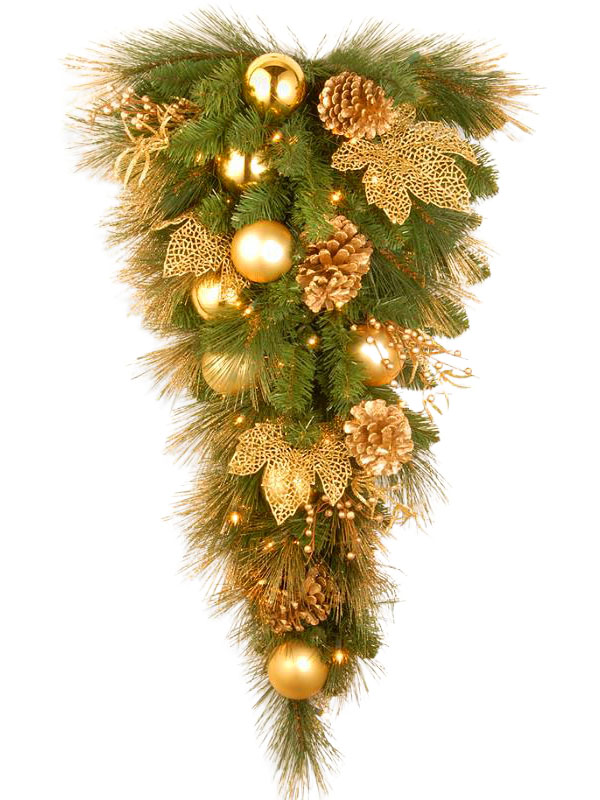
Christmas garland with lights is the most popular choice for adding warmth and sparkle without extra light strings. Pre-lit garland typically features 20 to 35 LED lights per 9-foot strand. Warm white LEDs create a classic glow; multicolor LEDs suit playful or vintage themes. When shopping, check whether lights are battery-operated or plug-in, as this affects placement flexibility on your tree.
Beaded garland (pearl, metallic, or crystal) adds elegance. Tinsel garland reflects light dramatically. Both are heavier than greenery options, so they require more branch support and may need to be secured with floral wire on artificial trees.
Wired ribbon woven through branches creates a cascading, boutique look. It's not measured the same way—typically, 2.5-inch ribbon at 3 yards per foot of tree is the standard guide, meaning about 21 yards for a 7 ft tree.
The structure of your artificial Christmas tree directly affects how garland drapes and stays in place. Here's what to look for:
Popular artificial Christmas tree styles that work particularly well with garland include full-profile Fraser fir, flocked white trees (which create striking contrast with dark berry garland), and slim pencil trees (where a single tightly spiraled garland strand is more appropriate).
For a cohesive holiday look, your tree garland and artificial Christmas wreaths should share at least one common element—foliage type, berry color, ribbon style, or light color. Here's how to coordinate effectively:
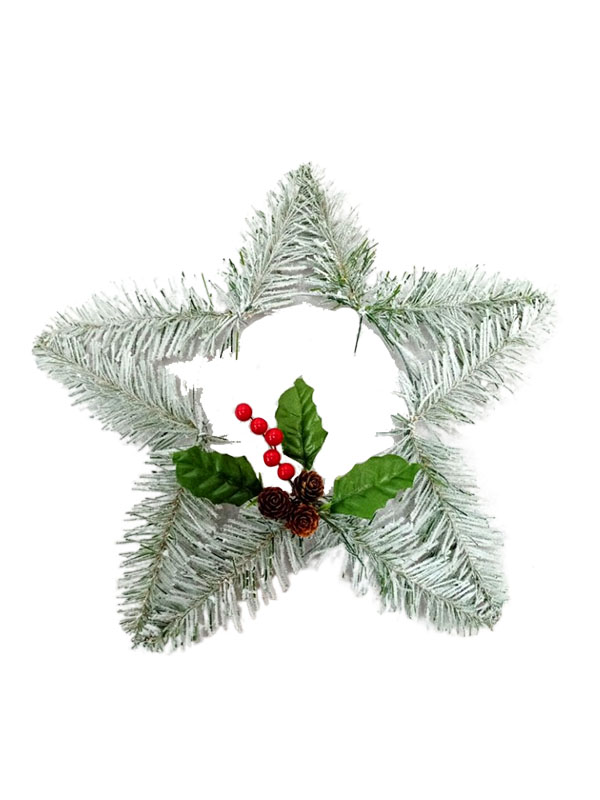
If your artificial Christmas wreaths feature mixed pine and cedar, use garland with the same blend. Many manufacturers sell wreaths and garland as matched sets—buying from the same product line guarantees visual consistency without guesswork.
If your wreath has red berries and pinecones, carry those accents into your tree garland. This creates a visual thread that ties your entire room's holiday decor together—from the front door wreath to the tree centerpiece.
Mixing warm white and cool white lights across wreaths, garland, and the tree itself creates visual discord. Stick to one light temperature throughout your entire display—warm white (2700K–3000K) for a cozy traditional feel, or cool white (4000K+) for a crisp modern aesthetic.
A standard front door wreath is 24 inches in diameter. For a mantel or window next to a 7 ft tree, an 18-inch wreath proportionally balances the tree's presence without competing with it.
Christmas garland with lights is one of the most versatile holiday decorations you can own. Once your tree is done, here's how to extend the look throughout your home:
Even experienced decorators repeat these errors. Knowing them in advance saves time, money, and frustration:
The most common mistake. Always round up to the next full strand. Running out mid-tree forces a second shopping trip or leaves the bottom looking sparse. For a 7 ft tree, buy at least 90 feet even if your calculation says 84—the buffer is worth it.
Artificial garland comes compressed from packaging. Spending 5 to 10 minutes bending and separating the branches before draping makes it look three times fuller on the tree.
Garland wound too tightly looks rigid and mechanical. Garland draped too loosely sags unevenly and falls off. The sweet spot is a loop depth of 6 to 8 inches below the branch plane, repeated consistently around the tree.
Heavy beaded or lit garland concentrated at the top can tip an artificial tree, especially narrower styles. Distribute the heavier sections through the middle tiers of the tree and use lighter garland toward the top.
Combining warm-white tree lights with cool-white garland lights creates an inconsistent glow that reads as a mistake rather than a design choice. Always test light color side by side before committing to your full display.
If you're decorating multiple trees or planning ahead for next season, use this table as a starting point:
| Tree Height | Minimum Garland | Recommended (Standard) | Full/Lush Look |
|---|---|---|---|
| 4 ft | 36 ft | 48 ft | 60 ft |
| 5 ft | 45 ft | 60 ft | 75 ft |
| 6 ft | 54 ft | 72 ft | 90 ft |
| 7 ft | 63 ft | 84 ft | 105 ft |
| 8 ft | 72 ft | 96 ft | 120 ft |
| 9 ft | 81 ft | 108 ft | 135 ft |
These figures assume a traditional round-profile tree. For slim or pencil-style artificial Christmas trees, reduce each figure by approximately 30 to 40 percent.
Our company was Established in 2003, it has been over 20 years.

NO.16, Xiaren Industrial District, Jinting Town, Shengzhou, Shaoxing City, Zhejiang Province, China.

+86-0575-83160278

 English
 Español