Export products to over thirty countries.
Mar 18,2026 / News
The fastest way to transform any room for Christmas is to anchor it with a tree, frame doorways and windows with wreaths, and layer in garland with lights for warmth and glow. These three elements alone — a Christmas tree, artificial wreaths, and lit garland — do roughly 80% of the decorative heavy lifting in most homes. The sections below break down exactly how to choose and use each one, with practical sizing, placement, and styling guidance.
Content
Your Christmas tree is the centerpiece of any holiday room. Before buying or assembling one, measure your ceiling height and the available floor space. A common rule of thumb: leave at least 12 inches between the tree's star or topper and the ceiling. For an 8-foot ceiling, that means a tree no taller than 7 feet.
Placement matters just as much as size. Position the tree in a corner to maximize visual impact while keeping walkways clear. Corners also let you "cheat" on branch fullness — you only need the front two-thirds to look dense.
Professional decorators typically work in three layers:
A standard 7-foot tree typically looks best with 400–600 lights and 60–80 ornaments. Going below these numbers often leaves the tree looking sparse and unfinished.
Artificial Christmas trees have become the dominant choice for American households — over 80% of trees set up in the U.S. each year are artificial, according to the American Christmas Tree Association. The primary reasons are reusability, cost savings over time, and zero needle cleanup.
When shopping for an artificial tree, pay attention to three specs: branch tip count, material type, and light pre-installation.
| Feature | Budget Option | Mid-Range | Premium |
|---|---|---|---|
| Branch Tips (7 ft) | 500–800 | 900–1,200 | 1,400–2,000+ |
| Material | PVC only | PVC + PE mix | Full PE or flocked |
| Pre-Lit | Often no | Sometimes | Usually yes (LED) |
| Estimated Lifespan | 3–5 years | 6–10 years | 10–20 years |
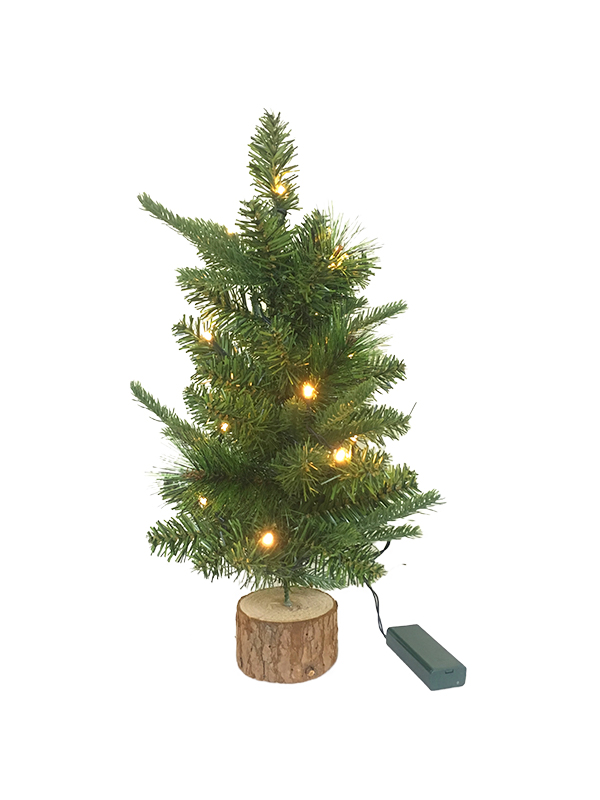
PE (polyethylene) branches look significantly more realistic than PVC because they are molded from actual tree branches. If budget allows, choose a PE or mixed PE/PVC tree for a more natural appearance. For small rooms or apartments, 4- to 5-foot tabletop trees are a space-smart alternative that still creates a real holiday focal point.
Wreaths are one of the most versatile Christmas decorations in any room. Beyond the front door, they can go on interior walls, above fireplaces, on stair landings, or even laid flat as a table centerpiece with a candle in the middle.
The right wreath size prevents it from looking lost or overwhelming:
Out of the box, artificial wreaths can look flat. Spend 5–10 minutes "fluffing" — pulling individual branch tips outward and layering them at varying angles. Add a wire-edged ribbon in 2.5-inch width woven through the greenery rather than just tied in a bow at the top; this creates a fuller, more dynamic look. Accent picks — pinecones, berries, or frosted stems — can be pushed directly into the wreath form to fill gaps.
Lit garland is the element that ties a decorated room into a cohesive whole. It creates visual flow — the eye follows the light from one area to the next — and adds warmth that static ornaments alone cannot replicate. A lit garland draped across a mantel, staircase, or bookshelf can make a room feel fully decorated even without a tree.
A commonly used rule for staircases: use 9 feet of garland per foot of staircase when draping loosely in a swag style. For a 12-step staircase (roughly 12 feet of banister), plan on 9–12 feet of garland. For mantels, a 6-foot mantel typically looks best with 9 feet of garland draped so the ends fall 12–18 inches below each side.
Pre-lit garland almost always uses either LED or incandescent bulbs. Here's how they compare for indoor room use:
For most indoor rooms, warm white LED lights (2700K–3000K color temperature) strike the best balance between energy efficiency and cozy holiday ambiance.
Rather than decorating room by room randomly, use a consistent color palette — typically two or three colors — across your tree, wreaths, and garland. This repetition is what creates a home that feels intentionally designed rather than assembled from mismatched purchases over the years.
A practical room-by-room checklist:
Start with the tree, then garland, then wreaths — in that order. The tree sets the scale, the garland sets the flow, and the wreaths fill the gaps. This sequence prevents over-decorating in one area while neglecting another.
Quality artificial trees, wreaths, and garland can last a decade or more with proper storage. The biggest enemies are crushing, moisture, and UV light from sunlight.
Store everything in a cool, dry place — a climate-controlled closet or indoor storage room is far better than an attic that swings between extreme heat and cold, which degrades both plastics and light wiring over time.
Our company was Established in 2003, it has been over 20 years.

NO.16, Xiaren Industrial District, Jinting Town, Shengzhou, Shaoxing City, Zhejiang Province, China.

+86-0575-83160278

 English
 Español