
Export products to over thirty countries.
Sep 23,2026 / News
Every December we hear the same story: the wreath that looked so lush in the product photos arrives in its box looking flat, squashed, and slightly disappointing. Nothing is wrong with it. As a manufacturer that has been producing Christmas wreaths since 2003, we can tell you honestly that almost every artificial wreath needs one simple thing before it looks its best: a good fluff. In this guide, our team walks you through how to fluff a wreath step by step, using the same techniques we apply when preparing wreaths for our showroom displays and photography. With roughly twenty minutes of gentle work, your wreath will go from compressed to full, round, and ready for the season.
Content
Artificial wreaths are packed tightly on purpose. Hundreds of branch tips are folded inward against the ring so the wreath fits safely into a carton and survives shipping without being crushed. After weeks in that position, the tips remember it, especially PVC strips, which hold a bend until you physically retrain them. A flat wreath out of the box is not a defect; it is simply a wreath waiting to be shaped.
Fluffing is the process of bending every tip back out to its intended angle. When each branch points outward and slightly upward, the wreath regains depth, its inner shadows return, and the greenery instantly looks far denser. This is also where quality shows: a wreath built on a sturdy frame with well-attached tips keeps its shape through years of fluffing, something we have refined across more than twenty years of manufacturing. If you want a reference point for natural, layered fullness, our Pine Needle Artificial Christmas Wreath is a good example of how structured branches should behave once shaped.
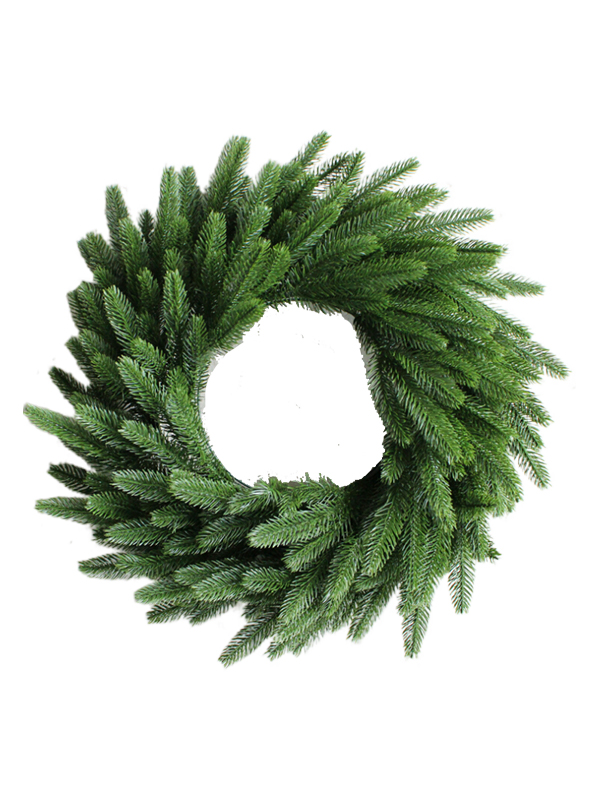 Pine Needle Artificial Christmas WreathA wreath with structured branches that hold their shaped angle, making it a useful reference for how proper fluffing should look once every tip is bent outward and upward.View Product →
You do not need any special tools. Gather these simple items and you are ready:
That is the entire setup. The rest is technique.
Whether you are shaping a small 45 cm door wreath or a large statement piece for above the fireplace, the method is the same. Work around the circle in one direction so you never lose track of where you started:
One pass is usually enough for a newly unboxed wreath, but a wreath that has been stored all year may need a second, quicker round after it has hung for a day and settled.
Not every wreath responds to fluffing in the same way. The material of the foliage changes how the tips bend, how much correction they need, and how carefully you should handle them. The table below summarizes what we tell our customers:
| Material | How It Behaves | Fluffing Tip |
|---|---|---|
| PE | Firm and realistic, holds its shape well | Needs the least fluffing; simply separate tips and vary their angles |
| PVC | Flat strips with strong memory of the box | Bend each strip outward and roll it slightly between your fingers to add curl |
| PE/PVC mixed | Combines realism with generous volume | Fluff PVC tips individually to build fullness around the PE tips |
| Pine needle style | Long, soft, flexible needles | Separate needle clusters in different directions for an airy, natural look |
| Flocked or snow finish | White coating can mark under hard friction | Shape with gentle pressure and avoid rubbing the flocked surface |
If low maintenance is your priority, choose a wreath that is engineered to need less correction in the first place. Our PE Series 45cm Christmas Wreath, for example, uses molded PE tips that keep their shape season after season, so fluffing becomes a five-minute touch-up rather than a full project.
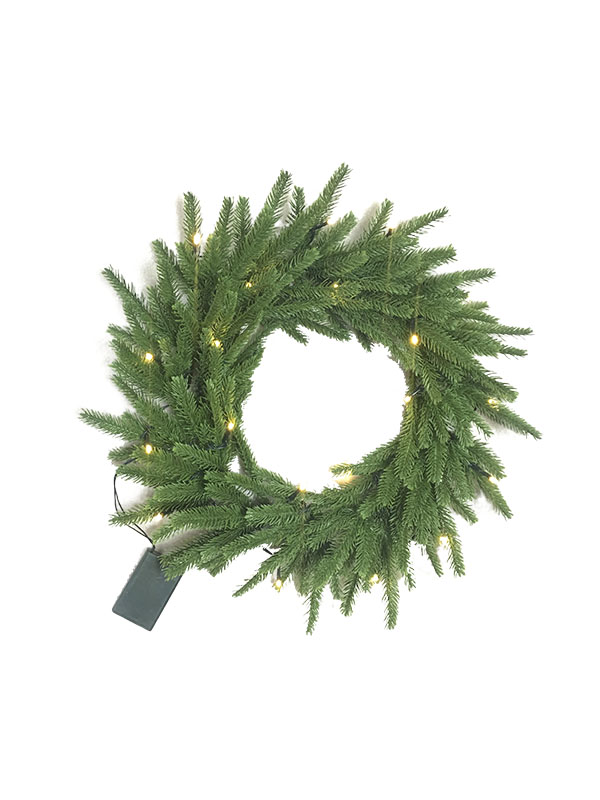 PE Series 45cm Christmas WreathMolded PE tips help this 45cm wreath keep its shape season after season, so routine fluffing becomes a quick touch-up instead of a lengthy project for low-maintenance decorating.View Product →
After two decades of watching wreaths being shaped on our lines and in our customers' showrooms, we have seen a few mistakes repeat themselves. Avoid these and your results will improve immediately:
A well-fluffed wreath stays that way with very little care. Indoors, keep it away from direct heat sources that can dry or distort the tips, and give it a gentle dusting now and then. Outdoors, sheltered positions such as a covered porch will preserve both the foliage and any attached decorations.
When the season ends, resist the urge to squash the wreath back into its original carton. Compressing it for eleven months simply recreates the flatness you just fixed. Store it in a dedicated wreath box or a bag that keeps the ring intact, and next December's fluffing will take minutes instead of half an hour. This matters even more for decorated designs such as our Artificial Christmas Wreath with Red Pine Cones, where careful storage protects both the branches and the ornaments attached to them.
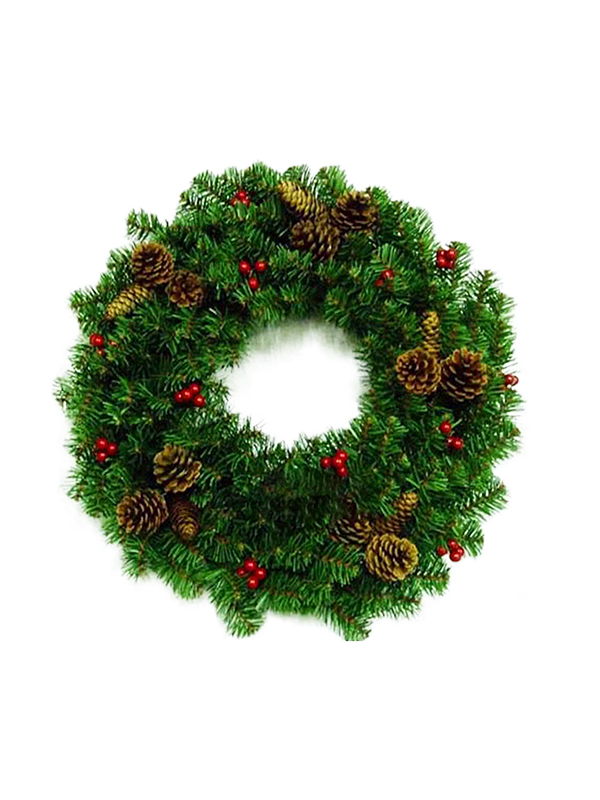 Artificial Christmas Wreath With Red Pine ConesDecorated with attached red pine cones, this wreath benefits from careful ring-preserving storage so both the branches and the ornaments stay intact between seasons.View Product →
Fluffing is the quiet step that separates a wreath that looks unboxed from one that looks decorated. It costs nothing but a little patience, and it rewards you every single time you walk through the door. Once your wreath is beautifully full, the natural next step is styling it: our guide on how to decorate a Christmas wreath covers ribbons, ornaments, and lights in detail. And if you are a retailer or project buyer sourcing wreaths that arrive well-made and fluff up beautifully year after year, our team at the factory is always happy to help.
Our company was Established in 2003, it has been over 20 years.

NO.16, Xiaren Industrial District, Jinting Town, Shengzhou, Shaoxing City, Zhejiang Province, China.

+86-0575-83160278

 English
 Español